
Pregnancy Aches and Pains: When Could Osteopathy Help?

Pregnancy changes your body. A lot.
Your centre of gravity shifts, your posture adapts, your abdominal wall changes, your pelvis is preparing for birth and areas of your body may suddenly be working in ways they weren’t nine months ago.
For some women, those changes happen relatively comfortably. For others, pregnancy can come with back pain, pelvic discomfort, aching hips, rib pain or symptoms that make walking, sleeping and simply turning over in bed feel considerably harder than they used to.
And this is where we need to challenge one of the things we hear far too often: Being pregnant doesn’t mean you simply have to put up with being uncomfortable. Some aches and pains can be a normal part of a changing body, but if discomfort is affecting your everyday life, it is worth seeking appropriate advice.
At Align Osteopathy in Totton, Southampton, we regularly see women during pregnancy who want help understanding what may be contributing to their musculoskeletal discomfort and what they can safely do about it.
So, let’s look at what’s actually happening to your body, when you should seek medical advice and where pregnancy osteopathy may fit into your care.
Why can pregnancy cause so many aches and pains? There isn’t one single reason.
Pregnancy involves a combination of physical, postural and hormonal changes, and every woman adapts differently.
As your baby grows, your centre of gravity gradually changes. Your abdominal wall stretches to accommodate your growing uterus and the way you stand, walk, sit and even get out of bed may start to change.
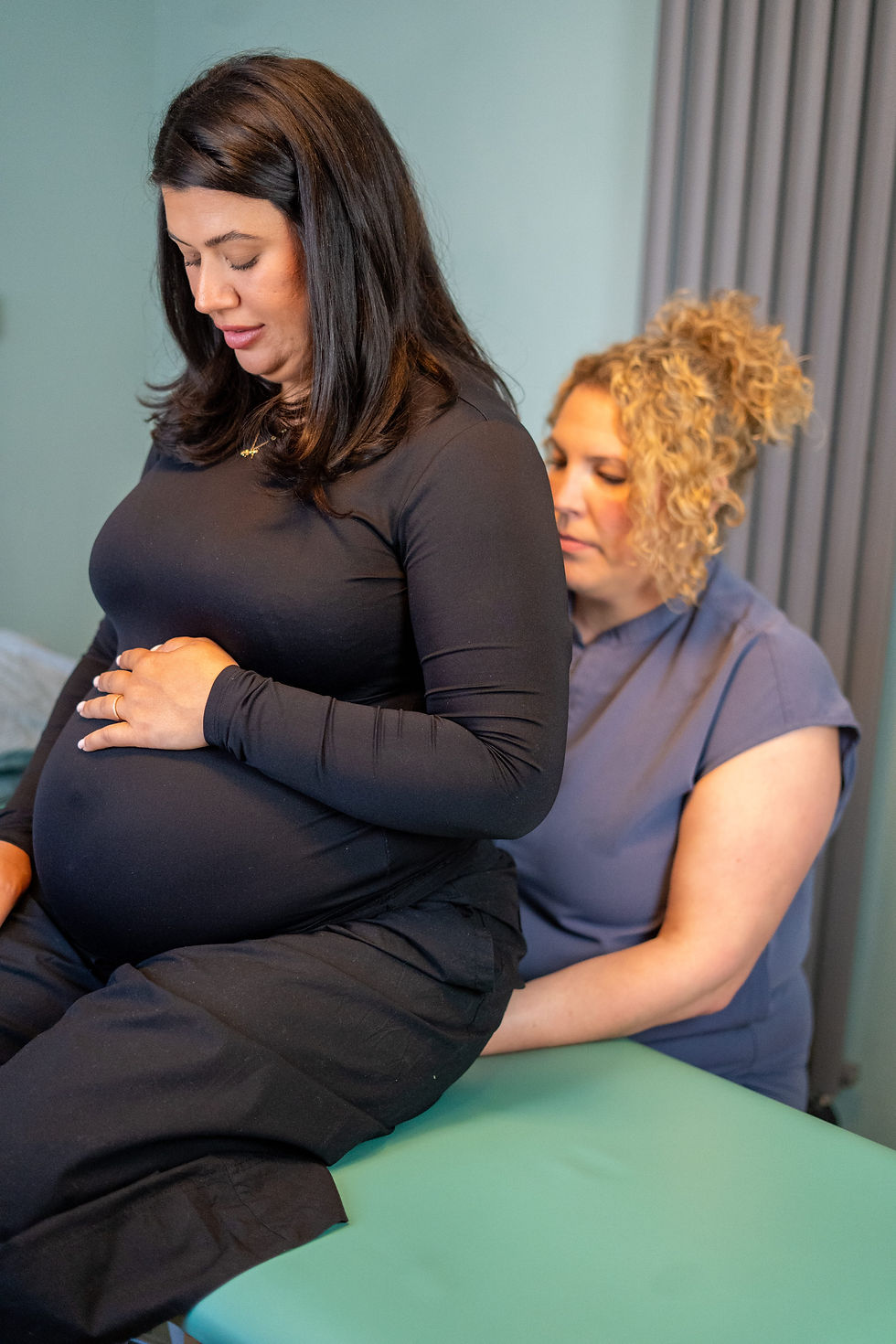
Your muscles and joints have to respond to those changes. Add in disrupted sleep, altered activity levels, carrying other children, working, commuting and everything else you continue doing while pregnant, and it’s perhaps unsurprising that certain areas can begin to feel uncomfortable.
Common musculoskeletal complaints during pregnancy can include:
Lower back pain
Pelvic girdle pain
Hip and buttock discomfort
Rib and upper back discomfort
Neck and shoulder tension
Pain or discomfort around the sacroiliac joints
Muscular aches and stiffness
Some women also describe pain travelling into the buttock or leg as “sciatica”. However, pain in this area can have a number of possible causes, so it’s worth having symptoms properly assessed rather than assuming the sciatic nerve is responsible. “But I’m pregnant. Isn’t being uncomfortable just part of it?” This is something we would love more women to question.
Your body is going through enormous changes, so experiencing some new sensations and occasional discomfort isn’t unusual.
But there is a difference between recognising that pregnancy changes your body and assuming that significant pain simply has to be endured until your baby arrives.
If you’re changing how you walk because something hurts, struggling to sleep because you can’t get comfortable, avoiding normal activities, or finding everyday movements increasingly difficult, speak to an appropriate healthcare professional.
Sometimes advice, changes to activity or appropriate treatment can help you manage musculoskeletal symptoms during pregnancy.
And sometimes symptoms need further investigation.
The important thing is not to dismiss pain simply because you happen to be pregnant. A real experience from one of our pregnant patients We recently received a message from a patient who visited Sarah at almost eight and a half months pregnant.
She had been experiencing significant pain for around three weeks and described how, following a few days walking in Cornwall, things had become considerably more difficult.
In her words:
“I could barely walk, found myself constantly holding my breath whenever I moved, turning over in bed felt like an extreme sport, and getting up required the kind of preparation usually reserved for mountaineering expeditions.”
Anyone who has been heavily pregnant and tried to turn over in bed may appreciate that description!
Following her appointment with Sarah, she contacted us to say that she was able to sit up and walk more comfortably and felt “much more human – and much more like myself”.
She also made the brilliant comparison that she felt like the grandad in Charlie and the Chocolate Factory when he suddenly gets out of bed.
We loved receiving her message, but there is something important to say here. This is one individual patient’s experience.
Pregnancy pain can have different causes, people respond differently to treatment, and her experience cannot be taken as a guarantee that another patient will experience the same result.
It does, however, highlight something we think is important: if pain during pregnancy is significantly affecting your daily life, it is worth talking to someone rather than automatically assuming nothing can be done until you give birth. What happens at a pregnancy osteopathy appointment? If you’ve never seen an osteopath before, you might be wondering what actually happens when you walk through the door.
Your first appointment starts with a conversation. We’ll ask about your pregnancy, your current symptoms, when they started, what makes them better or worse and how they’re affecting everyday things like walking, sleeping, working or exercising.
Your osteopath will then carry out an appropriate physical assessment, which may include looking at your movement and the function of relevant muscles and joints.
If osteopathic treatment is appropriate, this can usually be included within your appointment. Treatment is tailored to you, your stage of pregnancy, your symptoms and what we find during the assessment, using hands-on techniques appropriate to your individual circumstances.

And no, you won't be expected to lie in an uncomfortable position with a heavily pregnant bump!
We can adapt positioning throughout your appointment to keep you comfortable.
We may also discuss things you can try between appointments, such as modifying certain activities, changing positions more regularly or appropriate exercises or movement advice.
Importantly, we don't assume every pain in pregnancy is musculoskeletal. If something you tell us or we find during your assessment suggests that osteopathy isn't appropriate, we'll advise you to seek assessment from your midwife, GP, maternity team or another appropriate healthcare professional.
Osteopathy should complement your maternity and medical care, not replace it. When should I book a pregnancy osteopathy appointment? You don't have to wait until your discomfort becomes severe before asking for advice.
You might consider an osteopathic assessment if musculoskeletal pain or stiffness is:
Affecting your sleep
Making walking or everyday movement uncomfortable
Interfering with work or exercise
Making it difficult to find comfortable positions
Persisting despite simple changes to your routine
Causing you to change the way you move
Simply worrying you and you'd like professional advice
No two pregnancies are the same. Two women can be at exactly the same stage of pregnancy and have completely different experiences, which is why assessment and treatment should always be individual.
So, if you've found yourself Googling “Is this pain normal in pregnancy?” or thinking “I suppose I just have to put up with this until the baby arrives”, it may be worth asking for advice.
If you're concerned about a new or unusual symptom, contact your midwife, GP or maternity team as appropriate. If you're experiencing musculoskeletal aches or discomfort and would like an osteopathic assessment, you can contact us.
Pregnancy Osteopathy at Align Osteopathy, Totton We offer pregnancy osteopathy appointments for new and existing patients at our clinic in Totton, Southampton.
Not sure whether osteopathy is appropriate for what you're experiencing? Get in touch with the clinic and we can help you decide on the appropriate next step.
📞 023 81943275
💬 WhatsApp 07891718780
*The patient experience included in this article is an individual testimonial. Outcomes vary and the experience described should not be interpreted as a guarantee of results. Information in this article is general and is not a substitute for individual medical or maternity advice.


Comments